
Introduction
As the world moves towards a more connected and automated future, the automotive industry focuses on vehicle-to-vehicle communication (V2V) as a key focus area. V2V allows cars to wirelessly exchange real-time information concerning the speed, heading, and location of surrounding vehicles. Safety is a priority concern. Law enforcement officials also use V2V to track the location of vehicles, divert traffic, adapt traffic light programs, and tackle speed limits. For drivers, V2V communication helps them avoid traffic congestion and maintain a proper distance from other vehicles. It also allows drivers to park safely. V2V is used in modern fleet management.
V2V communication is particularly challenging in urban environments, where several obstacles, such as buildings, trees, and other vehicles, may interfere with communication signals. The Sub-GHz wireless communication technology uses low-frequency signals, typically below 1 GHz, to transmit data between vehicles, allowing them to communicate and exchange critical information.
What is Sub–GHz wireless communication
Sub-GHz wireless communication is an approach to V2V communication that operates at frequencies below 1 GHz. Wireless communication refers to the transmission of data in space using electromagnetic waves such as radio waves and infrared wavelengths. For some applications, the sub-1GHz unlicensed industrial, scientific, and medical (ISM) bands of 315, 433, and 902 to 928 MHz are ideal. With a given power level, receiver sensitivity, and antenna gain, lower frequencies inherently have longer-range transmission than higher frequencies.
It has several advantages over other wireless technologies, such as Bluetooth and Wi-Fi that operate at higher frequencies.
- It can penetrate obstacles and walls more efficiently, allowing for longer communication ranges and better coverage.
- Sub-GHz wireless communication is less susceptible to interference from other wireless devices and electromagnetic noise, which can degrade the quality of the communication signal. This makes sub-GHz wireless communication a good choice for applications that require reliable and robust wireless connections.
- It requires less power than higher-frequency signals, which can be critical in battery-powered devices such as electric vehicles. This lower power requirement also helps reduce interference and improve communication reliability.
Figure 1: Why Sub-1GHz RF technology
Sub- GHz wireless communication for V2V
V2V communication is crucial in developing autonomous vehicles and intelligent transportation systems. It enables vehicles to mutually communicate with roadside infrastructure, such as traffic lights and signs, to share information about road conditions, traffic flow, and other critical data. This information can improve safety, reduce congestion, and enhance the driving experience.
The V2V mechanism is one of the main components in the Vehicular Ad Hoc Network (VANET). The United States is using a predefined band of 5.9 GHz. IEEE 802.11p is used as a standard component in United States Vehicle To Vehicle current production implementation. VANET is considered a Mobile Ad Hoc Network (MANET) with some differences, like considering the vehicle as a node in the network. Also, the VANET network can include Dedicated Short-Range Communications (DSRC) used for the V2V mechanism.
The essential technical requirements for V2V communication in terms of the frequency range, power requirements, and communication protocols are as follows:
- Frequency range V2V communication systems operate in the 5.9 GHz frequency band, allocated by the Federal Communications Commission (FCC) for use in Intelligent Transportation Systems (ITS) applications. This frequency range is divided into vehicle-to-vehicle (V2V) communication and vehicle-to-infrastructure (V2I) communication channels.
- Power requirements V2V communication systems consume minimum power and extend the battery life of vehicles. The power requirements for V2V communication are typically in the range of milliwatts. They do not interfere with other wireless devices.
- Communication protocols The communication protocol used for V2V communication is IEEE 802.11p, a variant of the Wi-Fi protocol explicitly designed for use in vehicular environments. The IEEE 802.11p protocol uses a different modulation scheme and channel access mechanism than standard Wi-Fi to accommodate the high mobility and low latency requirements of V2V communication.
| Communication Technologies | Communication Protocols | Range | Characteristics |
| DSRC | IEEE 802.11p | 1000 m |
High Data Transfer Rate Reliable for large networks |
| Infrared | IEEE 802.11 | 10 m |
Reliable, mature and easy to master Low Power |
| Bluetooth | IEEE 802.15.1 | 10 m |
Good communication Security |
| Wi-Fi | IEEE 802.11a/b/g | 76~305 m | High Data Transfer Rate |
| UWB | IEEE 802.15.3a | 10 m | Strong anti-interference ability |
| Zigbee | IEEE 802.15.4 | 100 m |
Low Cost Low Power |
| MmWave | IEEE 802.11ad/IEEE 802.15.3c | 10 m | High Transmission Quality |
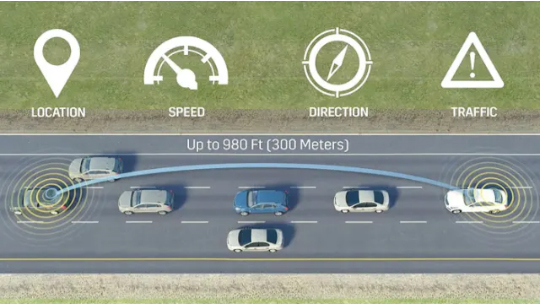
Figure 2: V2V communication
Working and its applications of Sub-GHz wireless communication in V2V
Sub-GHz wireless communication works in V2V communication by using radio frequency (RF) signals to transmit data between vehicles. The process involves encoding data into an RF signal using a radio transceiver, which is then wirelessly transmitted to another vehicle with a compatible receiver.
When a vehicle with a sub-GHz wireless communication system receives an RF signal from another vehicle, it decodes the data. The system then informs either the driver or the vehicle's control system. The transmitted data can include information on traffic conditions, road hazards, nearby vehicle positions, speeds, and directions.
The utilisation of a specific communication protocol known as Dedicated Short-Range Communication (DSRC) is a crucial aspect of sub-GHz wireless communication in V2V communication. DSRC is a wireless communication standard for V2V and vehicle-to-infrastructure (V2I) communication. It operates in the 5.9 GHz band while employing a variety of sub-GHz frequencies for various communication modes.
In DSRC, communication transpires via a sequence of basic safety messages (BSMs) swapped between vehicles. These messages include essential data such as the vehicle's position, speed, direction, and other significant details such as braking status and hazard warnings, as indicated in the accompanying diagram. The BSMs are transmitted at regular intervals and can be obtained and processed by other nearby vehicles.

Figure 3: Vehicle platooning
Use cases
Sub-GHz wireless communication can be used for V2V communication in several ways. One of the most critical applications is to support vehicle platooning, which involves a group of vehicles driving close to each other in a coordinated manner. Sub-GHz wireless communication can help the cars in the platoon maintain a safe distance from each other and react quickly to changes in driving conditions.
Another vital application of sub-GHz wireless communication for V2V is to provide early warning of potential collisions or other safety hazards on the road. By transmitting and receiving data between vehicles, it's possible to alert drivers to dangerous situations they may fail to detect independently. This can help prevent accidents and save lives.
Sub-GHz wireless communication is the future of V2V communication, offering a reliable and efficient way to transmit data between vehicles in real-time. This technology can improve our roads' safety and efficiency, reduce traffic congestion, and enhance the driving experience. With ongoing research and development, sub-GHz wireless communication will play a crucial role in developing intelligent transportation systems and adopting autonomous vehicles in the years to come.
element14 has partnered with many different suppliers catering to a wide range of Wireless connectivity products which includes RF Antennas, Wireless Transmitters, Wireless Monitoring Systems, Wireless Receivers, Bluetooth Antenna, ZigBee Transceivers, ZigBee Modules, Development Kits, Wi-Fi development kits, Wi-Fi Antenna, Cellular Antenna, Modules-cellular, are available to execute design, development, and projects.






ปัญญาประดิษฐ์
หนึ่งในการปฏิวัติที่ยิ่งใหญ่ที่สุดในประวัติศาสตร์ของมวลมนุษยชาติ! AI เป็นแนวคิดการรวมสิ่งต่าง ๆ เข้าไว้ด้วยกัน โดยนำความฉลาดของมนุษย์ใส่ลงไปในเครื่องจักร
DEVKIT HQ
The #1 Destination for Embedded Evaluation Boards, Development Kits, and Tools
ทรัพยากรทางเทคนิค
เราขยายห้องสมุดของเราอยู่ตลอดเวลา ห้องสมุดที่รวบรวมทั้งเอกสารระเบียบมาตรฐาน บทความทางเทคนิค วิดีโอ โมดูลการฝึกอบรม บทช่วยสอน และอีกมากมายเพื่อช่วยเหลือคุณในการพัฒนางานออกแบบ ธุรกิจ และหน้าที่การงานของคุณ
เทคโนโลยี
การใช้งาน






ทรัพยากรอื่น ๆ เพิ่มเติม
เครื่องคิดเลขและชาร์ทการแปลงหน่วย
คู่มือเลือกซื้อและแค็ตตาล็อก
โมดูลการเรียนรู้ขั้นพื้นฐาน
จุดเด่นด้านเทคโนโลยี
ทรัพยากรการออกแบบ
อภิธานศัพท์ทางวิศวกรรม
ฝ่ายสนับสนุนด้านเทคนิค
Parts Finder Tools
